

Our goal is to become your true partner in the field of ship loader in China. Jiangsu Zhendong Port Machinery Manufacturing is a professional port machinery manufacturing enterprise integrating product research and development, design, manufacturing and installation of port cranes. Our company has a strong technical force and experienced installation, debugging and after-sales service team. We serve customers with regular cycles, preferential prices, and good reputation, and continue to innovate and go global.
Why Choose Us
Our Certification
Our products have passed the international ISO9001:2000 standard quality system certification and CCS China Classification Society quality system certification, and have passed the ISO9001 quality management system certification. The company has the right to import and export on its own.
Product Application
Our main products include fixed load luffing cranes, fixed rack luffing slewing cranes, slewing hydraulic cranes, floating cranes, hydraulic cranes, etc. These products are widely used in cargo loading and unloading, stacking, dredging and lightering of engineering ships, and dock lifting operations in ports, power, metallurgy, and mining enterprises.
Production Equipment
Our company has gantry cranes, magnetic drills, CNC flame cutting machines, inverter CO2 gas shielded welding machines, CG1-30 semi-automatic flame cutting machines, submerged arc welding machines MZ-1000, bending machines, plate rolling machines, shearing machines, milling machines, lathes, sawing machines and other equipment.
Product Market
Relying on strong scientific research strength, our company's leading products have covered cities such as Shanghai, Dalian, Shenzhen, and Qingdao. Our products have opened up the international market and are exported to Southeast Asia, Africa, and developed countries in Europe.
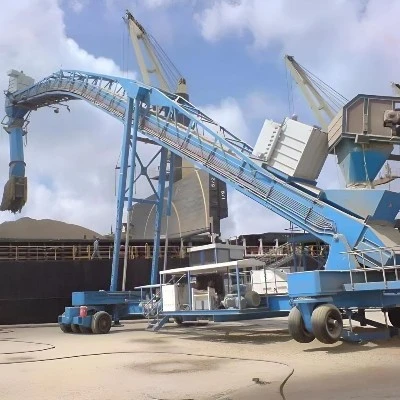
Advantages of Ship Loader
Increased loading capacity: Ship loaders can handle a wide range of cargo types and volumes. They are designed to accommodate different materials, including bulk commodities, aggregates, grains, ores, and more. These systems offer high loading capacities, allowing for efficient loading of large quantities of cargo onto vessels.
Reduced environmental impact: Ship loader are designed to incorporate environmentally friendly features. They often utilize dust suppression systems, noise reduction measures, and other eco-friendly technologies to minimize the impact on the surrounding environment.
Improved safety: Ship loader prioritize safety during loading operations. They are equipped with safety features such as interlocking systems, emergency stop buttons, and sensors to detect and prevent accidents. These systems can be operated remotely or from a safe distance, reducing risks for operators and ensuring safer working conditions.
Scalability and upgradability: Ship loader offer scalability and the ability to expand or upgrade as needed. Companies can easily adjust the equipment's capacity, add new features or functionalities, or integrate with existing loading infrastructure.

A shiploader is a large machine used for continuously loading bulk solid materials such as iron ore, coal, fertilizers, grains and/or material in bags onto ships or barges. These machines are located in ports and jetties to facilitate bulk material exportation.
Technical Parameters of Ship Loader
|
Maximum rated output |
5000t/h |
|
Applicable materials |
Various bulk materials |
Typse of Ship Loader
Fixed ship loader: Fixed ship loaders are stationary installations mounted on a fixed structure along the dock or quay. They have a fixed boom and conveyor system, making them suitable for ports with consistent loading requirements and limited space for maneuverability.
Mobile ship loader: Mobile ship loaders are mounted on wheels or tracks, allowing them to move along the dock or quay to different loading positions. These loaders offer flexibility in handling various vessel sizes and configurations, making them suitable for ports with multiple berths or changing loading requirements.
Telescopic ship loader: Telescopic ship loaders feature a telescopic boom that can extend and retract, providing flexibility in reaching different parts of the ship's hold. These loaders are adaptable to various vessel sizes and can accommodate changes in loading positions.
Continuous ship loader: Continuous ship loaders are designed for continuous and uninterrupted loading of bulk materials onto ships. They ensure a constant flow of cargo, reducing loading times and optimizing efficiency.
Pneumatic ship loader: Pneumatic ship loaders use air pressure to convey bulk materials from storage facilities to the ship's hold. These loaders are particularly useful for handling delicate materials or when dust suppression is a concern.
Articulated ship loader: Articulated ship loaders have an articulated structure that allows them to move in multiple directions, providing flexibility in positioning and aligning with different ship sizes and configurations. These loaders are useful for ports with challenging loading conditions.
Conduct a risk assessment and ensure a proper loading or discharge plan is in place. Verify the stability of the ship during operations to avoid excessive trim or heel. Check weather forecasts and consider adverse conditions that could affect operations.
Ensure personnel are wearing appropriate personal protective equipment (PPE), such as helmets, gloves, and safety shoes. Confirm firefighting and emergency response equipment is ready and functional.
Maintain clear communication between the ship and shore personnel. Use standard signaling or radios to avoid misunderstandings. Conduct toolbox talks or pre-operation briefings with all involved personnel. Ensure everyone is familiar with their responsibilities and the ship's safety procedures.
Ensure no cargo or debris falls overboard. Take precautions to prevent contamination from hazardous cargo. Cross-check cargo manifests with the physical condition of the cargo.

Customization of Ship Loader

Our loading systems are all specifically designed to our client's unique requirements and incorporate various solutions according to their specific application, including actual site conditions and the minimizing of environmental impact. As a result, no loader is the same and each is uniquely designed for purpose.
Our machines cover linear-type variants with rotating, raising and lowering shuttle booms and can be either rail-mounted or fixed/stationary. In addition, our ship loaders can be equipped with a variety of different loading chutes depending on specific applications, customer requirements and required environmental compliance.
Packaging and Shipping of Ship Loader
|
Packing |
Ordinary wooden boxes or frame wooden boxes |
|
Shipping |
Flatbed trucks, lowboy trailers, specialized heavy haul trucks |
We're well-known as one of the leading ship loader manufacturers and suppliers in China. Please feel free to buy high quality ship loader for sale here from our factory. Contact us for more details.
Tire Funnel, Dredging Grab, Single Arm Fixed Ship Loader